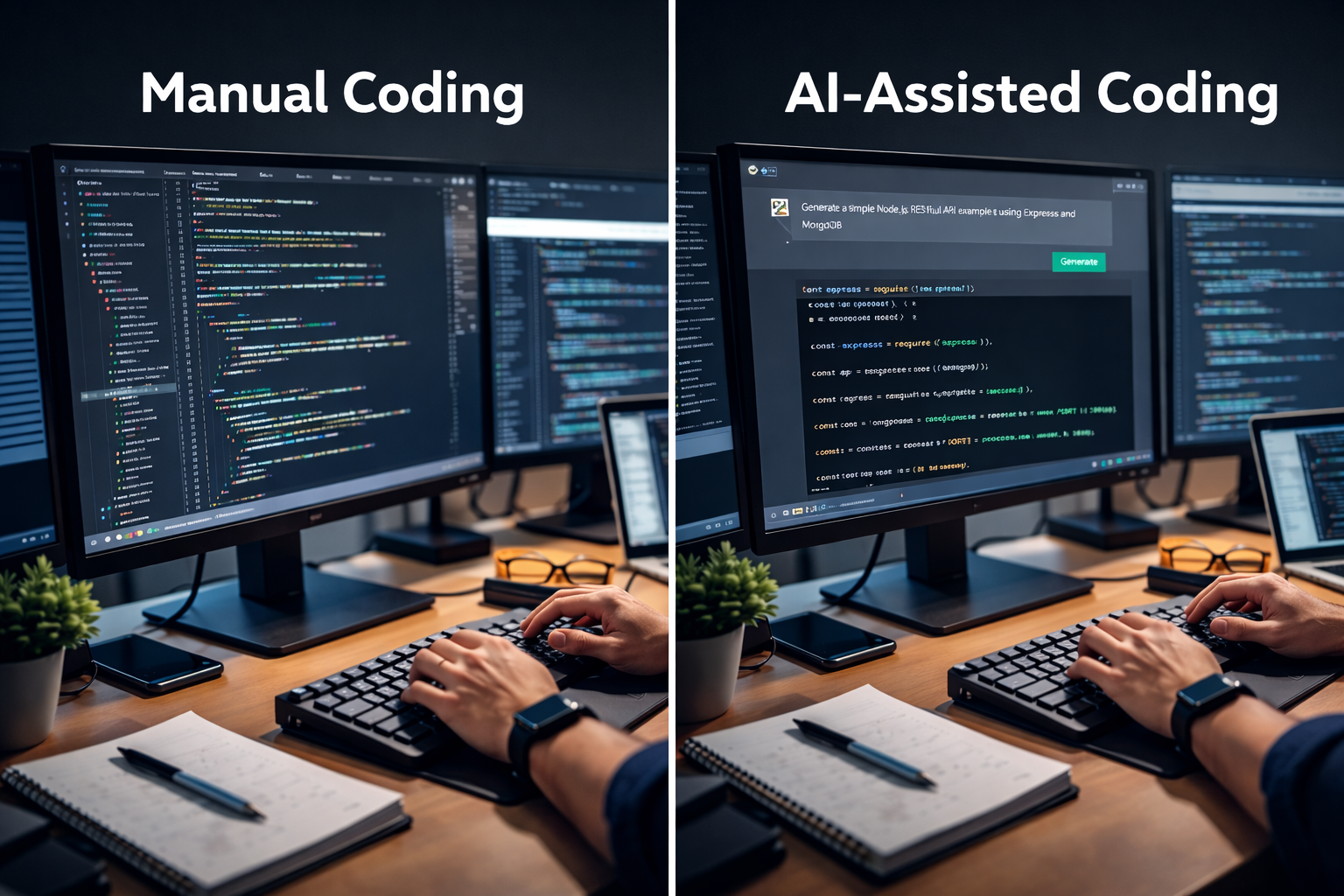
Software Development in the AI Era
By a Principal Software Engineer
I did not start my career as a software developer.
I started as an RF engineer, working on operators live data, networks, real-world constraints. From there, I moved into automation test engineering, writing frameworks and test case automation. That journey gradually pulled me into software development, and eventually into designing large-scale telecom, networking, edge and cloud systems.
Each transition reinforced one fundamental lesson:
coding is only a tool — engineering is the mindset.
This distinction matters more than ever today. AI-assisted development tools are delivering 20–50% productivity gains on routine coding tasks, and surveys show over 80% of developers now use AI for code writing. At the same time, recent security analyses find that around 45% of AI‑generated code contains at least one security vulnerability, with some languages seeing much higher rates. The gap between shipping code and engineering systems has never been wider.
Why Software Engineering Was a “Premium” Job
Software engineering earned its premium status not because engineers typed fast, but because they thought deeply.
In telecom and cloud systems, real engineering involved:
- Designing high-availability, fault-tolerant distributed systems
- Understanding network behavior, latency, retries, and failure modes
- Making architectural trade-offs under real operational constraints
- Owning systems that run 24×7 in production
- Debugging issues that never appear in test environments
As I moved from RF engineering to testing and then into development and design roles, the complexity increased—not due to syntax, but due to responsibility.
Senior engineers were valued because they could own outcomes, not just implement tasks.
The AI Shift: What Has Actually Changed
AI has fundamentally changed how software is built.
Today, AI can:
- Perform full-stack development
- Generate backend services and APIs
- Automatically document APIs
- Create frontend components
- Build DevOps pipelines, CI/CD workflows, and infrastructure templates
- Refactor, optimize, and explain existing codebases
- Write Test Cases, automate and execute
This is not an incremental improvement — it is a step-function change.
Work that once required multiple teams can now be prototyped by a single engineer using AI-assisted tools.
The Magnitude of Change: Numbers That Matter
Over the last few years, AI has moved from a novelty to table stakes in software development:
- Adoption: More than 4 out of 5 developers report using AI tools for at least some coding tasks.
- Productivity: Studies across multiple organizations show 20–50% productivity improvement on routine coding and boilerplate-heavy work.
- Code Volume: Teams can spin up full-stack prototypes in days instead of weeks, dramatically increasing the volume of code entering review and test pipelines.
- Code Duplication: Analyses of large repositories indicate AI-assisted development produces significantly more duplicated patterns and code cloning, multiplying future maintenance effort.
In other words, AI has made code cheap and abundant. The new constraint is no longer typing speed, but verification, integration, and decision‑making.
This naturally leads to a critical question:
If AI can do all of this, what exactly is the engineer’s role?
When Development Risks Becoming Just Manual Coding
When AI handles:
- Code generation
- API documentation
- Infrastructure provisioning
- Frontend wiring
- Testing
- Deployment automation
there is a real risk that engineers start functioning as operators of tools, rather than designers of systems.
The focus subtly shifts from:
“How should this system behave under failure and scale?”
to:
“Did the generated code run successfully?”
This does not happen because engineers are careless, but because AI makes it easy to skip deliberate thinking unless consciously resisted.
And when thinking becomes optional, engineering begins to lose its premium value.
The Hidden Costs of Moving Fast
Speed without judgment comes with compounding costs:
1. Security Debt Compounds Quietly
Recent security studies on AI-generated code have found that roughly 45% of such code contains at least one security flaw, with some ecosystems faring far worse. In one 2025 analysis, Java AI‑generated code showed vulnerability rates above 70%, while languages like Python, JavaScript, C#, and TypeScript still exhibited vulnerability rates around 40–45%.
AI does not understand security; it statistically reproduces patterns it has seen. That often includes:
- Unsafe string handling
- Insecure defaults
- Missing validation and authorization checks
- Incorrect use of cryptographic primitives
When teams blindly accept AI-generated code under delivery pressure, they accumulate security debt at unprecedented speed.
2. Code Cloning and Maintainability
AI tends to generate similar solutions to similar prompts, often without understanding the context into which the code is being inserted. Large-scale repository analyses show significant increases in code cloning with AI-assisted development.
This has practical consequences:
- Bug fixes must be applied to multiple near-identical locations.
- A subtle logic change requires hunting through many similar functions.
- Patterns diverge slightly over time, making systems harder to reason about.
What looks like a productivity boost today can become a maintenance tax tomorrow.
3. The “Operator Trap”
As AI takes over more of the keystrokes, engineers risk becoming:
- Prompt writers instead of system designers
- Verifiers of happy-path behavior instead of modelers of failure
- Integrators of black-box code instead of owners of architecture
When a serious incident hits production, tool operators struggle because they lack the mental models of how and why the system behaves as it does. They never had to build those models—AI handled “the details.”
What AI Still Cannot Replace
Despite its power, AI lacks contextual accountability.
In telecom and cloud systems, success is not just about correctness. It is about:
- Predictable behavior under extreme load
- Graceful degradation during partial failures
- Regulatory and compliance requirements
- Cost efficiency at scale
- Operational simplicity and debuggability
AI does not:
- Take responsibility for production outages
- Understand historical design decisions
- Know the business impact of latency or downtime
- Own trade-offs across teams and long-term roadmaps
From RF systems to distributed cloud platforms, the hardest problems are not about code—they are about decisions under uncertainty.
AI can suggest.
Only engineers can decide.
The New Meaning of a “Premium” Engineer
The premium has not disappeared—it has shifted.
In the AI era, premium engineers are not defined by:
- The volume of code they write
- Their familiarity with the latest tools
- Their ability to ship features quickly
They are defined by:
- How well they frame problems
- How deeply they understand system behavior
- How responsibly they use AI-generated output
- How clearly they design and communicate architectures
- How confidently they own production systems
AI excels at execution.
Engineering remains about judgment.
The Bifurcation Is Already Happening
Market data and compensation trends show a clear bifurcation:
- Entry-level roles that primarily implement specifications and consume AI output are seeing modest or declining premiums; basic AI usage is becoming a baseline expectation, not a differentiator.
- Senior engineers who can integrate AI safely, enforce quality, and reason about systems command double‑digit compensation premiums.
- Staff and principal engineers with strong system design and architectural skills are seeing some of the fastest-growing compensation premiums, often in the 20–30%+ range, especially where they can lead AI‑enabled teams.
In other words, the premium is no longer on who can code,
but on who can think, decide, and take responsibility.
Three Types of Engineers Emerging in the AI Era
As AI becomes ubiquitous, engineering careers are increasingly diverging into three archetypes:
1. The Tool Operator
- Uses AI to write code faster and fill in gaps in knowledge.
- Measures success mainly in tickets closed and LOC changed.
- Relies heavily on generated code without deeply understanding underlying systems.
- Career ceiling: Typically mid-level engineer.
- Risk: As AI tools get better, the relative advantage of “being good with AI prompts” shrinks.
2. The Responsible Integrator
- Uses AI extensively, but always reviews, tests, and hardens what it produces.
- Owns code review, testing, and basic security considerations.
- Can explain what the code does, not just that it runs.
- Career ceiling: Senior engineer, tech lead.
- Risk: Without deeper architectural thinking, may get stuck resolving local issues instead of shaping systems.
3. The Systems Architect
- Treats AI as a force multiplier, not an autopilot.
- Focuses on architecture, failure modes, trade-offs, and lifecycle ownership.
- Uses AI to explore design options but makes the final calls on what to build and how it behaves.
- Career trajectory: Staff, principal, distinguished engineer, and beyond.
- Reward: Increasingly scarce and highly valued as more of the “typing” gets automated.
The same AI tools that flatten the early-career landscape amplify the gap between these archetypes. Tool operators become easier to replace; systems architects become harder.
How Engineers Should Adapt
Based on my journey across RF, automation, development, and system design, a few principles stand out.
1. Prioritize Thinking Over Typing
Code generation is now abundant; clarity of thought is not.
Before asking an AI to generate code, ask yourself:
- What problem am I really solving?
- How will this component interact with the rest of the system?
- What happens under peak load? Under partial failure?
If you cannot answer these questions, generating more code only increases your risk surface.
2. Treat AI Like a Very Fast, Very Literal Junior Engineer
AI is fast and helpful, but it does not learn from your corrections the way a human does. It will happily repeat the same class of mistakes in slightly different forms.
Treat AI as you would a junior engineer, with critical differences:
- Never skip review. Especially for security, concurrency, and reliability-sensitive code.
- Interrogate assumptions. Ask: What are the failure modes this code assumes away?
- Refuse black boxes. If you do not understand the generated code, you do not own it.
Your job is not just to get code that compiles; it is to ensure the system behaves predictably over time.
3. Strengthen System Fundamentals
The more AI accelerates coding, the more system fundamentals become your differentiator:
- Networking: Latency, throughput, backpressure, congestion, retries.
- Distributed systems: Consensus, replication, consistency models, partition handling.
- Reliability engineering: SLOs, error budgets, graceful degradation, circuit breakers.
- Observability: Logging, tracing, metrics, and how to use them during real incidents.
These are not optional details; they are the terrain on which AI-generated code will run—or fail.
4. Own the Entire Lifecycle
Premium engineers do not just “hand off” their work. They:
- Design
- Build
- Test
- Deploy
- Operate
- Debug
- Evolve
If AI helps you build faster, use the saved time to get closer to operations. Sit in on incident reviews, read postmortems, and trace actual user impact back to design decisions.
5. Develop Domain Depth
My RF background, telecom protocol knowledge and strong networking basics still informs how I reason about latency, reliability, and failure today. Domain depth gives you intuition that AI does not have.
- In telecom, you think in terms of jitter, propagation delay, and protocol constraints.
- In finance, in terms of regulatory constraints and risk tolerance.
- In healthcare, in terms of safety, ethics, and compliance.
AI can replicate patterns; domain experts shape constraints.
What This Means for Careers and Compensation
The industry is clearly bifurcating:
- Engineers who primarily consume AI output
- Engineers who direct AI using judgment and experience
Entry-level coding will continue to commoditize. AI will make it easier and faster to:
- Implement CRUD services
- Wire frontends to APIs
- Scaffold infrastructure templates
- Translate business requirements into working prototypes
But engineers who can:
- Design systems
- Evaluate AI-generated solutions
- Balance technical and business trade-offs
- Own failures in production
will remain scarce—and highly valued.
Compensation data from 2024–2025 reflects this:
- Entry-level AI usage yields only modest salary uplifts; AI familiarity is becoming standard.
- Senior engineers with AI and system design capability earn noticeable premiums over peers focused solely on implementation.
- Staff and principal engineers who can architect and govern AI‑accelerated teams see some of the highest compensation growth in the market.
The premium is no longer on who can code,
but on who can think, decide, and take responsibility.
Conclusion: AI Won’t Kill Engineering—But It Will Redefine It
AI can:
- Build full-stack applications
- Generate APIs and documentation
- Write backend, frontend, and DevOps code
What it cannot do is be accountable.
My journey—from RF engineering to automation testing to development and system design—has reinforced one truth:
Tools evolve.
Engineering principles endure.
Coding is becoming automated.
Engineering is becoming more demanding.
If you want to stay on the premium side of that divide, ask yourself:
Could I debug this system at 2 AM?
If your answer depends on re‑prompting an AI instead of understanding the system, you are not engineering it.Do I understand the trade-offs?
Can you explain why this architecture is the right choice among alternatives, or is “the AI suggested it” your only justification?Am I accountable?
If this system fails, can you explain what happened, why it happened, and how you will prevent it next time?Did I think harder than the AI?
If your work was mostly copying prompts and accepting outputs, you are operating tools, not shaping systems.Is this simpler than it needs to be?
The most dangerous AI-generated code is not obviously complex; it is deceptively simple code that hides subtle failure modes.
The real question every developer must ask today is not:
“Will AI replace me?”
It is:
“Am I merely using AI to write code—or am I still engineering systems?”
References
[1] Morgan Stanley Research, “How AI Coding Is Creating Jobs,” October 2025. Analysis of AI adoption in software development and market growth projections.
[2] World Economic Forum, “Future of Jobs Report 2025.” Research on skill transformation and AI fluency as essential competencies; 39% of job skills expected to transform by 2030.
[3] Veracode, “2025 GenAI Code Security Report.” Security vulnerability analysis of AI-generated code; 45% overall vulnerability rate, with language-specific variations (Java: 72%, JavaScript: 45%, Python: 40%, C#: 42%, TypeScript: 38%).
[4] Veracode Security Analysis, 2025. AI-generated code security risks and comprehension gap challenges for development teams.
[5] GitClear Analysis of 153M Lines of Code. Research showing 4x increase in code cloning with AI-assisted development compared to traditional development practices.
[6] McKinsey & Company, “Generative AI and the Future of Software Development,” 2025. Productivity gains analysis (20–50% improvement on routine coding tasks) and bottleneck identification in code review and testing phases.
[7] GitHub Survey on Developer Productivity with Copilot, 2024–2025. 88% of developers using AI coding assistants reported improved productivity perception.
[8] Levels.fyi, “AI Engineer Compensation Trends Q3 2025.” Compensation premium analysis across career levels: entry-level AI specialists (6.2% premium, down from 10.7% in 2024); senior engineers with AI expertise (14.2% premium); staff engineers (18.7% premium, up from 15.8% in 2024); principal engineers (22–30% premium for architectural expertise).
[9] Rise, “AI Talent Salary Report 2025.” Career progression and compensation trends in AI-accelerated organizations.
[10] Aeqium, “Compensating Software Engineers in 2025: A Guide for Compensation Leaders.” Framework for understanding premium compensation for system design and architectural skills.
[11] InfoQ, “Architectural Trade-Offs: The Art of Minimizing Unhappiness,” 2024. Distributed systems design trade-offs and long-term architectural impact.
[12] Ably, “Engineering Dependability and Fault Tolerance in a Distributed System,” 2022–2025. Principles of high-availability systems, failure modes, and redundancy strategies.
[13] Codacy and IBM Research on Technical Debt, 2025. Relationship between code quality, technical debt accumulation, and long-term system maintainability with AI-assisted development.
[14] GeeksforGeeks and Academic Sources, “Fault Tolerance in Distributed Systems” and “System Design Trade-offs.” Foundational concepts on Byzantine failures, consistency models, and failure mode analysis.
[15] StatsIG, “Handling Failures in Distributed Systems: Patterns and Anti-patterns,” January 2025. Production incident patterns and mitigation strategies relevant to AI-generated code integration.