Designing Process in the Age of Scale and AI

Is process a guardrail that prevents failure — or a speed limit that slows excellence?
Executive Summary
- Process reduces chaos, but it does not affect everyone equally.
- People who thrive with independence often experience heavy process as constraint.
- People who benefit from structure often experience the same process as clarity.
- When the wrong balance of influence shapes process, organizations either become rigid or overly intense.
- AI shifts leverage from execution to defining standards.
- Leadership today is less about adding or removing process — and more about calibrating it.
The Paradox of Process
As organizations grow, they formalize how work gets done.
What once relied on trust and judgment becomes documented. What once required conversations becomes workflows and approvals. This is natural. Process reduces variability, protects against risk, and makes scale possible.
But here is the paradox:
The same system that prevents failure can quietly limit excellence.
The tension is not between order and chaos. It is between stability and independence.
Every team contains people who operate comfortably with minimal oversight — and others who benefit from clearer guidance and defined steps. A single process applied to everyone will inevitably feel different to different people.
The question is not whether process is good or bad.
The question is: Who does it serve best?
Why Process Feels Different to Different People
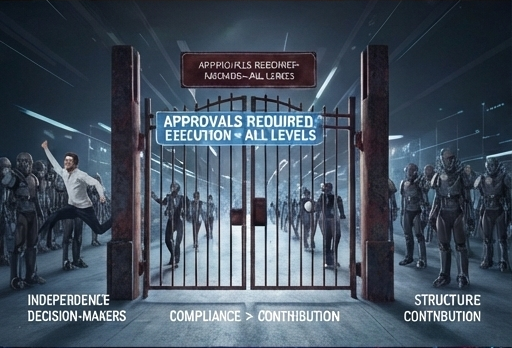
Some individuals are highly independent. They make decisions quickly, navigate ambiguity comfortably, and learn by doing. For them, too many checkpoints feel like friction.
Others prefer clearer direction. Defined expectations reduce uncertainty. Structured workflows provide confidence. For them, process feels enabling.
Neither group is right or wrong. They simply operate differently.
Research on motivation consistently shows that autonomy fuels engagement and performance (Deci & Ryan, 2000). At the same time, organizational research shows that structure reduces confusion and improves coordination (March & Simon, 1958).
Process therefore plays two roles:
- It protects the organization.
- It shapes how individuals experience their work.
And those experiences are not uniform.
When Process Becomes Rigid

Problems emerge when process expands primarily to reduce risk, protect decision-makers, or eliminate ambiguity at all costs.
In such environments, you often see:
- Increasing documentation requirements
- Multiple approval layers
- Escalation as a default response
- Reduced decision authority at lower levels
Over time, compliance becomes more visible than contribution.
People who are capable of operating independently begin to feel slowed. Decision cycles lengthen. Initiative decreases. Not because talent disappears — but because discretion shrinks.
Research distinguishes between “enabling” and “coercive” forms of bureaucracy (Adler & Borys, 1996). The former supports performance. The latter protects against error at the cost of agility.
Rigid process rarely emerges intentionally. It grows gradually — often in response to past failures.
When Process Becomes Intense
The opposite imbalance can be just as damaging.
Sometimes systems are shaped primarily by those who operate comfortably at high speed and high standards. Processes are streamlined aggressively. Expectations escalate. Tolerance for mistakes narrows.
In such environments:
- Iteration cycles are compressed.
- Learning curves are shortened.
- Feedback is direct and fast.
For experienced contributors, this can be energizing.
For those still building confidence or mastery, it can be overwhelming.
Research on psychological safety shows that people learn best when they feel safe to experiment and make mistakes (Edmondson, 1999). When performance pressure consistently outweighs developmental space, growth can stall.
Short-term output may remain strong. Long-term resilience may weaken.
In both cases, the issue is not process itself — but imbalance.
AI Changes Where Process Lives

Artificial intelligence introduces a new dimension to this discussion.
AI compresses execution time. Code, analysis, content, and design can now be generated in seconds. What once required hours of manual effort is now automated.
This does not eliminate process.
It moves it.
When execution becomes faster, defining standards becomes more important.
The critical questions shift:
- Who defines what “good” looks like?
- Who decides acceptable risk?
- Who sets review criteria?
- Who approves outputs?
In AI-enabled environments, process lives in specifications, evaluation frameworks, and governance rules.
If standards are unclear, AI amplifies inconsistency.
If standards are rigid, AI amplifies rigidity.
The influence shifts toward those who define expectations — not those who merely execute tasks.
This makes calibration even more important.
The Leadership Challenge: Calibration, Not Control
Leaders often debate whether they need more process or less process.
That framing is outdated.
The real task is calibration.
Effective systems recognize that people operate at different levels of independence and experience. Good design adapts accordingly.
Four principles help:
1. Expand Autonomy with Demonstrated Reliability
As people prove judgment and consistency, reduce unnecessary oversight. Process should contract as trust increases.
2. Provide Structure Where It Adds Confidence
For those building mastery, clarity enables growth. Structure should scaffold development — not signal distrust.
3. Revisit Process Regularly
Systems that once solved real problems can become outdated constraints. Review governance intentionally.
4. In AI Contexts, Govern Standards Thoughtfully
As AI accelerates execution, leaders must focus on defining quality, risk tolerance, and accountability clearly.
Process should protect against collapse — not prevent acceleration.
From Stability to Sustainable Excellence

Process is not the enemy of performance.
But poorly calibrated process is the enemy of sustainability.
When too rigid, it protects against failure but discourages initiative.
When too intense, it drives output but suppresses development.
The strongest organizations understand that process is not static. It must evolve as teams mature and technology changes.
In the AI era, the ability to define standards may matter more than the ability to execute tasks.
The leaders who succeed will not eliminate structure.
They will design it deliberately.
Not as a speed limit.
But as a guardrail.
References
Adler, P. S., & Borys, B. (1996). Two types of bureaucracy: Enabling and coercive. Administrative Science Quarterly, 41(1), 61–89.
Deci, E. L., & Ryan, R. M. (2000). The “what” and “why” of goal pursuits: Human needs and the self-determination of behavior. Psychological Inquiry, 11(4), 227–268.
Edmondson, A. (1999). Psychological safety and learning behavior in work teams. Administrative Science Quarterly, 44(2), 350–383.
March, J. G., & Simon, H. A. (1958). Organizations. Wiley.